Home / Destinations / Religious / Buddhism /
Matale Aluviharaya
Last updated on 16 Jun 2023Show location
Aluvihara evolved from Aloka Vihara. The name Aluvihara has several different meanings in folklore. One is that the Pali term Aloka was Alu (light) in ancient Sinhala and as it was the residence of Theras, it was a Viharaya. Hence the two terms have been formed to make it Aluvihara.
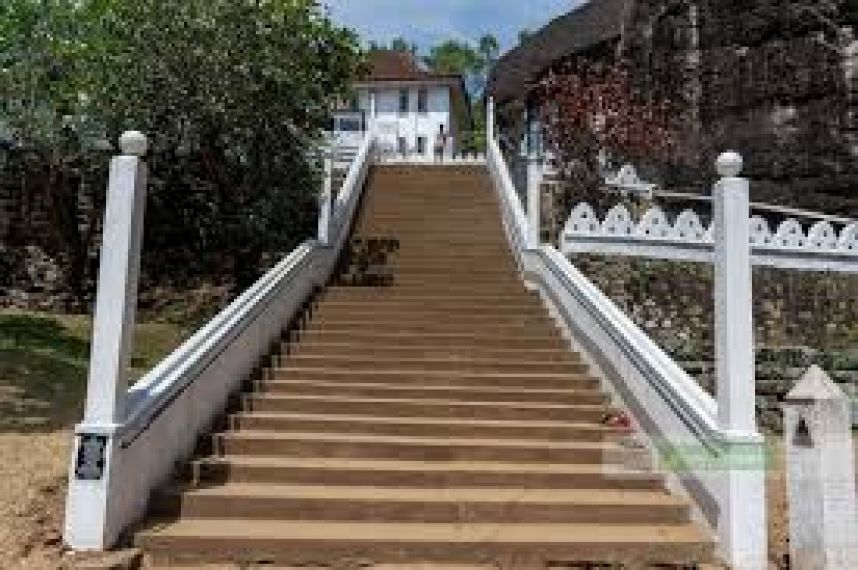
Another perspective holds that despite the presence of a sizable rock east of the main rock cave, the light has not been blocked. Consequently, it was referred to as the Aloka Lena (cave with light). The famed Aluvihara cave temple, which is encircled by hills and is located 30 kilometers south of Kandy on the Matale-Dambulla route, is very significant historically. Aluvihara's history may be traced back to the reign of King Devanampiyatissa in the third century B.C. The dagoba and the Bo sapling are believed to have been constructed by the King. According to the trustee of the Viharaya, Ven. Dr. Inamaluwe Nandarathana Thera, on June 1, 2012, the Department of Agriculture in Peradeniya inspected the tree and moved a root so it would grow in another direction to avoid a piece of a rock. The Ven. Thera claims that it thereafter began to grow and is currently quite tall. There is a belief that a huge landslide in the hill country caused the rock caves. There are currently thirteen rock caverns. Three years ago, the Ven. Dr. Inamaluwe Nandarathana Thera removed three caves that were covered in dirt and overgrown with bushes. When he visited the temple grounds as a small boy, he recalled seeing these hidden rock. He cleaned the caves with his own money. He reveals that the kitchen is in one of the caves. The roof is dark, which he attributed to the soot, and there is a broken portion of what he described as a wall. People now visit these caves on Poya days to observe "Sil" and meditate there. He thinks there are still undiscovered caves, and he aspires to find and explore them someday. One must climb a number of steps in order to enter the Aluvihara. There is a rock cave with artwork and statues inside the Viharaya. The paintings depict "Anothattha Vila," "Dahamsonda Jatakaya," "Huridattha Jatakaya," "Maithri Bodhisattva," among other figures, according to the Ven. Dr. Inamaluwe Nandarathana Thera. The "Vessantara Jatakaya" has been painted in another portion. A "Makara Thorana," "Doratupala" statues, paintings of lions, and flags with the sun and moon are displayed at the entrance. A "Bo" tree was carved onto a rock that was examined. A footprint (Sri Pathula) and the forms of two oil lamps could be seen on another rock that was climbable. This rock's immediate surroundings included a hole that local legend explains King Walagamba used to escape and into hiding. A painting of the Maha Rahathan Theras writing the Tripitaka on talipot leaves may be found in the "Sangayana Lena" (rock cave). The Tripitaka (Buddhist texts Vinaya Pitaka, Abhidhamma Pitaka, and Sutra Pitaka) was written in Pali in Aluvihara, which is significant. The Buddha's teachings—the Dhamma—were verbally (mukha paramparawa) transmitted from one generation to the next after his "Parinirvana" (death). The "Baminithiyasaya" famine, which lasted for 12 years in the first century B.C., occurred under King Walagamba. At the same period, there was an invasion by South India. The Anuradhapura Mahavihara Bhikkhus were also split up. The bhikkhus understood that the Buddha Dhamma would be in peril as a result of these issues. They had a rough time and were forced to eat yams, roots, and leaves due to the famine. It was challenging to memorize and recite the Dhamma in these circumstances. About 60 Bhikkhus departed Anuradhapura for Malaya Rata, which is thought to be a hill country, while some traveled for India and others left Anuradhapura. They endured difficult living conditions along the Mahaweli River's banks. Animal corpses were seen. The Buddha Dhamma was in danger of being lost, and the Theras were weak and aware of this.

The bhikkhus who traveled to India and the hill country survived the first twelve years and King Walagamba's return from concealment after fourteen years before returning to Kallagama Janapadaya. To preserve the Dhamma for future generations, it was resolved at the Mandalaramaya that the "Tripitaka" should be written. They opted on "Aloka lena" at Mathula Janapadaya after realizing that Anuradhapura was inappropriate for this purpose (Aluvihara in Matale). Maha Thera Kunthagattha Tissa, who was at Thuparama, served as their guide as they chose 500 Maha Theras for this reason. They traveled to Aluvihara and, under the sponsorship of a chief named Mathula Janapadadipathi, authored the Tripitaka in Pali. According to Ven. Dr. Inamaluwe Nandarathana Thera, it is thought that one set of the Tripitaka is buried in a rock at Aluvihara, another set is kept in the Abhayagiri dagaba, and a third set is kept in the library there. The writing took more than three years to complete, and it was finished on a Vesak Poya day. To commemorate the occasion, King Walagamba had ordered all viharayas on the island to hold a "pahan pooja" (the burning of oil lamps). This celebration became into an annual procession that began at Rajamaha Kohon Viharaya and ended at Aluviharaya. However, with time, this custom ended. A Committee was established to look into the historical and cultural facets of Aluvihara in 1971 after discussions between the Government Agent in Matale and the Ministry of Cultural Affairs. Following that, it was designated as a protected area and archeological heritage. This Committee sanctioned the construction of two halls at the 'Pahatha Maluwa' for the use of worshippers. The "Sangayana Perahera" was revived in 1973 to honor the completion of the Tripitaka, and it is held every year at Aluvihara, Matale, on the full moon Poya day of June. In the fifth century A.C., the scholarly monk Buddhaghosa is said to have traveled to Aluvihara. He read the comments on the Buddhist texts and verified them. Some Buddhist literature have been lost during the Dutch era. The British Army stormed Aluvihara later in 1848, setting fire to and destroying some library texts. However, the temple had been later repaired by the British government. The Most Venerable Ethipola Medhankara Nayaka Thera is the Aluvihara Rajamaha Viharaya's current Viharadhipathy (Chief Incumbent). He rewrote the Tripitaka with the help of four people who knew how to write on talipot leaves, including an Ayurvedic physician. From 1981 to 1991, this process took ten years. These Talipot leaf manuscripts are currently kept in the library. This most significant religious and cultural Aluvihara Raja Maha Viharaya is said to have been conserved and repaired by Kings Maha Parakramabau of Polonnaruwa, King Nissanka Malla, and King Sri Wijaya Rajasinha.