Home / Destinations / Historical / Ruins /
Embekke Arts
Last updated on 26 Jun 2023Show location
It was constructed during King Wickrema Bahu II's Gampola reign, according to ancient texts and the epic Embekke Varnanawa written by Delgahagoda Mudiyanse (1371 AD).
According to a wonderful dream, one of his consorts, Henakanda Biso Bandara, erected this Devale for God Kataragama in a magnificent three-story structure that is no longer standing, together with a drummer by the name of Rangama. The Digge (Dancing Hall) and Drummers Hall are two separate buildings where the devale is located (Hewasi Mandappaya). I found the following ones to be particularly fascinating. These beautiful wood carvings were expertly carved from the wooden capital pillars, giving them a variety of different shapes. The apex of the top square culminates in a leaf emerging from the bottom square, which is carved into an octagon. The Pecada is resting on another intricate yet distinctive work of woodcarving. Several beams, rafters, doorways, and doors have attractive woodcarvings cut into them as well. The following are some of the finest works of art on the capital pillars: Hansa Puttuwa (entwined swans), double-headed eagles, and entwined rope designs; a mother nursing a child; a soldier engaged in horseback combat; female dancing figures; wrestlers; women emanating from a vein; a bird with a human figure; and combinations of an elephant and a bull and an elephant and a lion. The elephant-bull carving and the elephant with its protruding, mystically materialized trunk caught my attention the most among these amazing carvings. When the carving of a bull is covered with one's palm, the true carving of an elephant with a lengthened trunk appears, but when one does the same with the carving of an elephant, the bull magically appears.
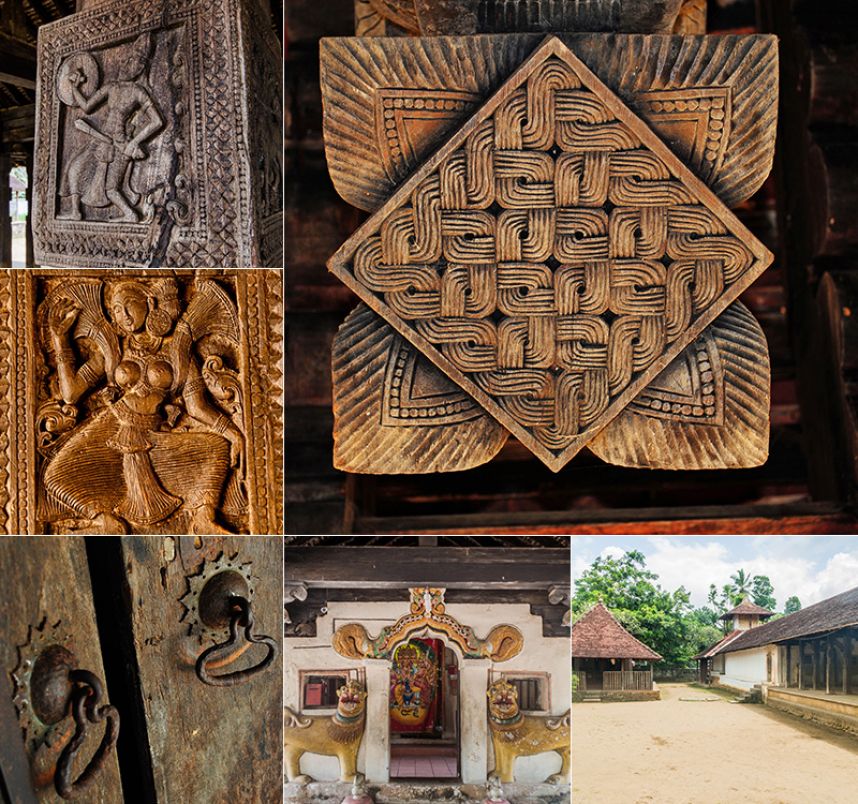

The Embekke Devale's ceiling contains several inventive reveals of classical carpentry masterpieces in the rafters' fitting. The "Madol Kurupuwa" is among the finest specimens of superb medieval carpentry. The Madol Kurupuwa, a wooden pin, is what keeps 26 rafters together at the hipped end of the roof of the Digge of Embekke Devale. Patha designs called pathuruliya are etched on the enormous pin. There are 514 such excellent carvings in all, including 125 series of ornaments, 256 liyawel, 64 lotus designs in Pekada, and 30 artistic patterns on timber, roof parts. Everything is good at Embekke Devale except for the unwelcome posters that have been stuck to the parapet wall facing the road. These posters are particularly offensive to international visitors. To avoid such inappropriate signs being plastered on the wall and defacing this historic site, the caretakers should be informed. Another group of stone pillars with exact reproductions of the wooden pillars of the Embekke Devale carved on them is located a short distance distant, roughly one-eighth mile. There are sixteen of these columns in all, each with two octagonal portions above, a square block in the middle, and a square block at the end with carvings on all four sides. The carved wooden capitals (Pekada), which are no longer visible at the site, are thought to have supported the wooden beams of the roof. Flat tiles had been used to cover the roof. Some of the carvings on these stone columns, which are similar to the woodcarvings at Embekke Devale, include rope designs, an intertwining swan, a berunde bird, and a dancing girl. The residents still recall the Ambalama with the wooden roof existing roughly 100 years ago. An image from Henry Cave's 1908 book "Book of Ceylon" depicts the roof's original condition. The Ambalama is constructed on a platform with four seven-foot-tall monolithic columns at each corner and is 27 feet long by 22 feet broad. Another name for this structure is Sinhasana Mandapaya. When the perahera was held in the past, the monarch and his royal entourage would repose here.