Home / Destinations / Animal watchin... / Wild animals a... /
Udawalawa National Park
Last updated on 02 May 2023Show location
At the beginning Udawalawe National park was a forest reserve established in 1972. Before naming it as a National park all the shifting cultivators were removed from the area. Udawalawe National Park serves as the catchment area for Udawalawe reservoir. it is more popular for its herds of elephants, aquatic birds, and herds of wild buffaloes. October to April is the best time to visit Udawalawe. The Udawalawe National Park in Sri Lanka is a popular destination and ranks as the third most visited park in the country. Due to its diverse range of habitats, the park is home to various animals. However, the main attraction of Udawalawe is the elephants, with an estimated 600 to 700 elephants residing in the park. Despite the focus on elephants, many other species of wildlife are found in the park, including the endemic Toque Macaque and the Sri Lankan Leopard, although sightings of the latter are rare. The Sri Lankan Sloth Bear has also been recorded in the park, but sightings are infrequent. Additionally, the park is home to numerous species of birds, some unique to Sri Lanka, as well as fish, reptiles, and amphibians.
Udawalawe National Park, located on the boundary of Sabaragamuwa and Uva Provinces in Sri Lanka, was established as a national park on June 30, 1972, covering an area of 30,821 hectares. Its purpose was twofold: to provide a sanctuary for wild animals displaced by the construction of the Udawalawe Reservoir on the Walawe River and to protect the reservoir's catchment. Before its establishment, the area was used for shifting cultivation or chena farming, and farmers were gradually removed once the park was declared. About 165 kilometers (103 mi) from Colombo, Udawalawe is a popular tourist destination and the third-most visited park in the country. It is an essential habitat for water birds and Sri Lankan elephants, with a resident herd of 600 to 700 elephants believed to be living in the park. The Sri Lankan elephant is the main attraction at Udawalawe. Still, the park is also home to other species of Sri Lankan wildlife, such as the endemic Toque Macaque and the Sri Lankan Leopard, although the latter is rarely seen. The Sri Lankan Sloth Bear has also been recorded but is seldom seen. There are numerous species of birds, some of which are endemic, along with fish, reptiles, and amphibians.
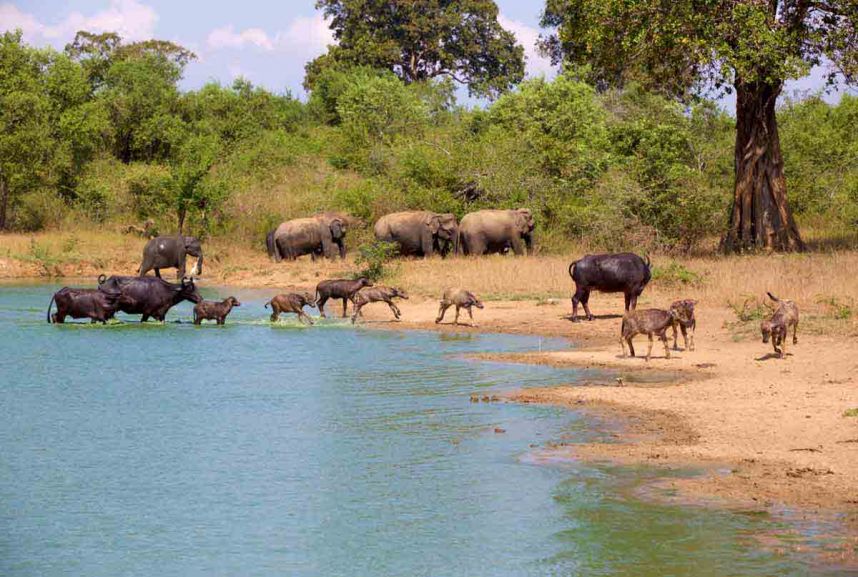

The best time to visit Udawalawe is generally from January to March, during which rainfall is at its lowest, and daytime temperatures average a comfortable twenty-six degrees Celsius. It is the best place in Sri Lanka to see wild Asian elephants throughout the year, as there are about 500 elephants in the park, often roaming in herds of up to 100. The Udawalawe National Park is well-known for being home to a significant population of Sri Lankan elephants, a subspecies of Asian elephants. Visitors to the Park are often treated to these majestic creatures gathering to feed and bathe at the waterholes. The park houses around 600 to 700 of these elephants, providing a fantastic opportunity to witness them in their natural habitat. The Sri Lankan Elephant is a threatened species, and the August 2011 census estimated that approximately 5,800 of them are on the island. Aside from elephants, Udawalawe is also home to a diverse range of Sri Lankan wildlife. These include the Rusty-spotted Cat, Fishing Cat, Sri Lankan Leopard, Sri Lankan Sambar Deer, Sri Lankan Axis Deer, Indian Muntjac, Sri Lankan Spotted Chevrotain, Wild Boar, Water Buffalo, Golden Jackal, Asian Palm Civet, Toque Macaque, Tufted Grey Langur, and Indian Hare. The park also has a large population of Golden Palm Civets, five species of mice, Indian Bush Rat, and three species of Mongoose. Udawalawe is also a birdwatcher's paradise, with 183 recorded bird species in the park. Many others also pass through on their migratory routes, making it an ideal spot for bird safaris. The park's avifauna includes a wide range of Warblers, low country birds in forested areas, and several species of raptors. Visitors may also spot rare water birds like the Indian Cormorant and Osprey on the reservoir. Notable endemic bird species in the park include the Sri Lanka Spurfowl, Sri Lanka Junglefowl, Malabar Pied Hornbill, and Brown-capped Babbler.