Home / Destinations / Heritage / Natural /
Anuradhapura
Last updated on 27 Apr 2023Show location
Anuradhapura is a community in Sri Lanka's North Central Province's Anuradhapura District. Sangha Mitta, the founder of an order of Buddhist nuns, carried a cutting from the "tree of enlightenment," the Buddha's fig tree, to this sacred city in the third century B.C. Following an invasion in 993, Anuradhapura, the governmental and religious center of Ceylon for 1,300 years, was abandoned. The magnificent site, with its palaces, monasteries, and monuments, is once again approachable after spending many years hidden away in thick jungle.
Anuradhapura is a part of Sri Lanka's North Central Province. One of Sri Lanka's former cities, Anuradhapura is renowned for the exceptionally well-preserved ancient Lankan civilization ruins. The city, which is now a UNESCO World Heritage Site, is located 205 kilometers north of Sri Lanka's present capital, Colombo. There are numerous ruins in and around the holy city of Anuradhapura. The structures in the remains are divided into three categories: dagobas, monastic buildings, and Pokuna (ponds). Being in a dry region of the nation, the administration constructed numerous tanks to irrigate the land, giving rise to some of the most intricate irrigation systems in all of ancient history. Tamils and Sri Lankan Moors also reside in the area, but Sinhalese make up the majority of the population. The Cultural Triangle also contains Anuradhapura, the ancient capital of Sri Lanka and the center of its ancient culture. Anuradhapura, located 205 kilometers from Colombo, has some well-preserved remains of ancient palaces and other structures.
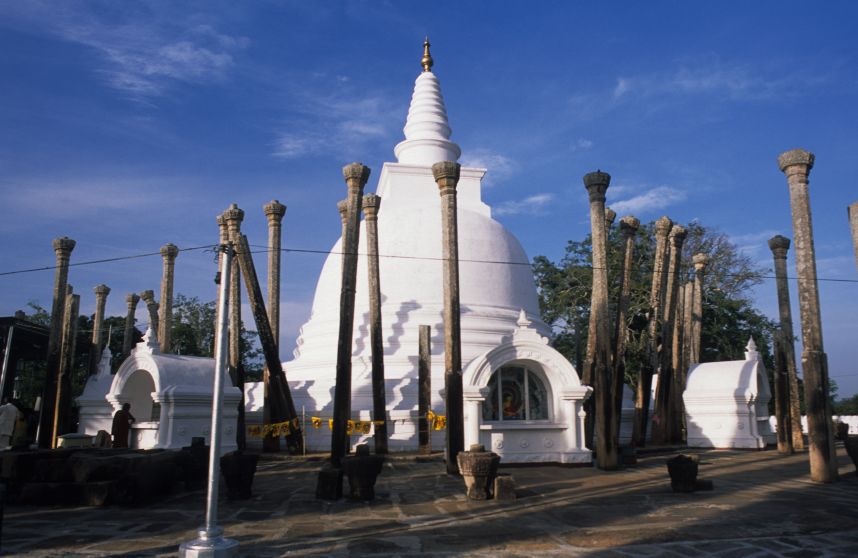

One of the most stirring sites in South Asia is the Anuradhapura ruins. The vast complex is home to a diverse array of archaeological and architectural marvels, including enormous dagobas (brick stupas), historic pools, and dilapidated temples constructed during Anuradhapura's 2,000-year reign over Sri Lanka. Special places in Anuradhapura: • Sri Maha Bodhiya • Ruwanweliseya • Thuparamaya • Lovamahapaya • Abhayagiri Dageba • Jethavanaramaya • Mirisaweti Stupa • Lankarama • Isurumuniya a) Sri Maha Bodhiya The sacred Bodhi tree is central to Anuradhapura in both a spiritual and physical sense. It was raised from a cutting imported from Bodhgaya, India, and is regarded as the oldest historically documented tree in the world. For more than 2000 years, it has been protected by an unbroken line of keepers. Currently, thousands of devotees visit to give sacrifices, especially on weekends and poya (full moon) days. A lovely moment to travel is at sunset. The devout think Princess Sangamitta, sister of Mahinda (who brought Buddhism to Sri Lanka) and daughter of Indian Emperor Ashoka, carried the cutting from India. It's been a while since I've done this, but I've been meaning to for a while now. Prayer flags are draped over the railing and other structures surrounding the trees. As part of a bigger offensive that claimed the lives of almost 150 civilians in 1985 during the civil war, the Tamil Tigers opened fire within the enclosure, killing a number of worshippers. Since pilgrims assemble at the location for snana puja, April and December are particularly busy months (offerings or prayers). Since then, Buddhist monks and devoted kings have taken care of and maintained the Jaya Sri Maha Bodhi, as it came to be known. Over the years, the tree has been surrounded by statues, waterways, walls, and gilded fences, and Buddhists have made several vows and offerings at its base. The tree has occasionally been in danger, and not just from wild elephants. Two storms in 1907 and 1911 caused branches to break. In 1929, a vandal hacked another branch off the tree. Separatists from the Tamil Tiger attacked the location in 1985 and slaughtered 146 Sinhala Buddhists on the upper terrace. The UNESCO has proposed Anuradhapura as a candidate for World Heritage status. The Jaya Sri Maha Bodhi was the primary factor in Anuradhapura's transformation into a sacred city. b) Ruwanweliseya. Ruwanweliseya is one of the glorious ancient stupas situated in the city of Anuradhapura. It was built by King Dutugemunu who became the king of Sri Lanka after a war in which Chola King Elara was defeated. Ruwanweliseya is also named the Maha Stupa which means the great Dagaba, and it is also named as the “Swarnamali Chaitya”, “Suvarnamali Mahaceti”, and “Rathnamali Dagaba”. One of the tallest ancient structures in the world is called Ruwanweliseya. Its height is 103 meters, and its circumference is 290 meters. Many monarchs are claimed to have restored the stupa, which had an estimated height of 55 meters originally. This is one of the Solosmasthanas and Atamasthanas (the sixteen shrines). Many Buddhists from all around the world see this as a hallowed location. The Mahawamsa provides a thorough account of the stupa's construction and dedication ceremonies. Inside the Mahamewna Uyana, the Ruwanweliseya is situated near to the Sri Maha Bodhiya. The Mahawamsa and the Thupavamsa historical chronicles go into considerable detail about its construction. Several artisans and craftsmen were employed in the construction of the large stupa, which is supposed to have been magically supplied with the materials needed from various locations on the island. At a lavish ceremony, the king is said to have housed Buddha relics inside the bubble-shaped stupa. Although the monarch was determined to finish the stupa during his lifetime, this was not to be since he became ill. Prince Saddhatissa instructed the craftsmen to cover the incomplete stupa in white cloth in order to make it appear to be finished in order to realize his older brother's dream. King Dutugemunu passed away thinking the Ruwanweliseya was finished as a result. The stupa was built during the time of King Saddhatissa, and it was maintained for many years by his successors before finally falling into disrepair once the kingdoms moved south. Ruwanweliseya Stupa (Ruwanveli Seya Stupa), the foremost of the supremely glorious ancient living monuments of Sinhalese Buddhist Heritage at the city of Anuradhapura (a UNESCO World Heritage Site-Culture) was built by King Dutugemunu (161-137 BC), the Hero of the Nation, who hailed from Ruhuna, which was destined to give birth to most of the glorious heroes of the island nation of Sri Lanka from the ancient era to the modern day. A wall with a frieze of 344 elephants standing shoulder to shoulder guards this stunning white Dagoba. With the exception of a handful by the western entrance, the majority are contemporary replicas of the originals from 140 BC. It currently rises 55m, which is far less than its original height, and does not have the same form as the former "bubble" shape due to extensive destruction from invading Indian armies. A portion of the Buddha's ashes are said to have been interred here during the dagoba's consecration, which was witnessed by monks from Rajagriha, Vaishali, Patna, Kashmir, and Afghanistan. It had a 7-meter-deep base built of limestone that had been smashed with hammers and then crushed by elephants; at the time, it was the largest stupa in the world. King Dutugemunu ordered Ruvanvelisaya, but he did not live to see it finished. To ensure that Dutugemunu could see his "finished" work before passing away, a fake bamboo and cloth finish was applied around the Dagoba while he lay on his deathbed. It is often believed that a limestone statue in a tiny pavilion south of the large Dagoba is of Dutugemunu. c) Thuparamaya The Mahawamsa claims that under the time of King Devanampiyatissa, the Thuparamaya was the FIRST STUPA constructed in the historic city of Anuradhapura. It is revered by Sri Lankan Buddhists since tradition has it that it contains Lord Buddha's right collarbone. The Mahamewna Uyana, which houses Thuparamaya, is a highly revered Buddhist site in and of itself. It was rebuilt in 1842 since it had grown somewhat deteriorated over time. The Thuparamaya is nine feet six inches tall at its base, and although its stupa is the only substantial part that has survived, it is thought to have formerly housed a residential complex. The complex, which surrounded the stupa, would have occupied a three-acre area based on the remains of the building. Despite being mostly in ruins, the temple's vatadage (circular relic house) nonetheless exudes a mystical yet welcoming ambiance because to the pillars that surround the stupa. A stupa house, or vat adage, is a distinctive building element on this stupa. The stupa was entirely housed within this structure. The stupa is currently surrounded by four concentric circles of stone pillars. These used to support the weight of a dome-shaped roof above the stupa, but as you get closer to the innermost rings, they became shorter. This stupa building was supported by 176 pillars, and in 1896, 31 whole pillars with capitals were still in place. This aphorism about the vat dates back to the first century A.D. The stupa was encased in gold and silver in the seventh century BC, and the stupa dwelling, or vatadage, had golden doors and bricks. The stupa's gold, jewels, and other treasures were then stolen by Pandyans (South Indian Tamil). Mahinda IV (956–972) once more replaced the golden casings and doors, but Colas (a south Indian Tamil) once more stripped the complex of all of its riches in the late 10th century. The most ancient stupa had a full renovation in 1862, which radically altered its original design. The preserved remnants of an Image house from this stupa complex can be seen to the stupa's left. This was constructed by king Devanampiyatissa in the third century BC, and 600 years later it was destined to be the first building on the island to contain the Buddha's Tooth Relic and claim the title of first Dalada Maligawa. At the front of the structure, a lovely pair of guard stones may be seen. It is unusual for a building in Anuradhapura to have pillars that still have their lotus-shaped crowns and smooth, polished surfaces after more than two millennia. The ruins of a small building with the two smaller guard stones and a granite entryway are situated next to this. An old granite-block well is located close by. A little stupa by the name of Padalanchana Stupa can be seen on the other side of the walkway leading to the stupa. The Thuparamaya’s characteristic bell form and rows of stone pillars enclosing the stupa are still visible to visitors today. The area around the temple bears evidence of a vatadage that was constructed there in the past. The Thuparamaya is known to have been destroyed over the years by a number of different causes and natural disasters. It has undergone numerous renovations over the years; the most recent one is believed to have taken place in the 19th century CE and left the Dagoba with a base circumference of 59 feet and a height of just over 11 feet. The Thuparamaya has been recognized by the government of Sri Lanka as an archaeological site. d) Lovamahapaya In the historic city of Anuradhapura, Sri Lanka, there is a structure called Lovamahapaya that is situated between Ruvanvelisaya and Sri Mahabodiya. Due to the bronze tiled roof, it is also known as the Brazen Palace or Lohaprasadaya. The structure formerly housed a refectory and an uposathagara (Uposatha house). Moreover, a simamalake was where the Sangha gathered on Poya days to recite the confessional's sutra. A building of this type is the well-known Lohaprasadaya, which King Dutugemunu erected and was described as a nine-story structure. The building has a 400-foot (120-meter) long side. There are 1600 pillars in all, arranged in forty rows, each row having forty stone pillars. The building's construction is said to have taken six years, and the design was provided by the heavens. Under the reign of King Saddhatissa, the structure was completely destroyed. The structure is thought to have had a chapter house, assembly hall, and refectory. The term "Brazen palace" comes from the bronze tiles that covered the roof. The building's 400-foot-long walls were supported by 1600 stone pillars in 40 rows of 40, the majority of which are still standing today. Historical accounts claim that the Brazen Palace was a stunningly intricate and jewel-encrusted building in its heyday. However Lovamahapaya original structure in Sri Lanka was long since demolished during the reign of King Saddhatissa. The Maha Vihara monastic order today resides in a contemporary chapter house that is located amid the actual forest of pillars.