Home / Destinations / Heritage / Natural /
Polonnaruwa
Last updated on 27 Apr 2023Show location
The capital of the Polonnaruwa District in Sri Lanka's North Central Province is Polonnaruwa. The other portion of Polonnaruwa, which is still regarded as the ancient royal city of the Kingdom of Polonnaruwa, is also known as New Town. It is a long-forgotten, antiquated capital that has recently been resurrected.
In 368 CE, Sri Lanka's kings moved into Polonnaruwa (Polonnaruwa), which took over as the nation's capital in the eighth century when Anuradhapura was conquered by Tamils. In the 20th century, a nearby old irrigation reservoir was restored to meet the demands of the local agricultural region, where rice and tobacco are farmed. This led to the emergence of the current town. There is a train station as well. The majority of the Buddhist temples and other buildings in the town date back to the 12th century. The largest intact building is a 170 foot (52 meter) long structure with walls that are 12 feet (3.5 meters) thick and around 80 feet (24 meters) high. Some magnificent ruins have also been meticulously excavated and preserved. In 1982, the historic city received the UNESCO World Heritage designation. After Anuradhapura was destroyed in 993 AD, the capital of Sri Lanka was moved to Polonnaruwa, the country's second-oldest monarchy. The urban green metropolis that King Parakramabahu I built has witnessed several civilizations passing through this kingdom, including the Cholas, South Indian Hindus, and Buddhist Sinhalese, throughout the 12th and 13th centuries.
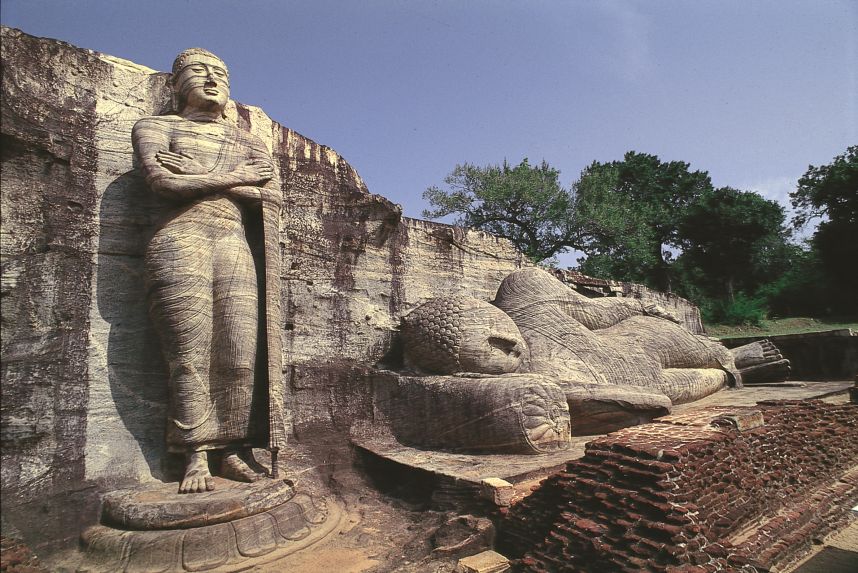

The city is filled with temples, shrines, palaces, and ruins and is brimming with archaeological treasures. Discover the royal residence of King Parakramabahu I. (1153 – 1186). The majestic walls that formerly surrounded a huge building with fifty rooms still stand strong today. Intricately carved stone elephants flank the walls of the king's audience hall, where lion sculptures stand guard. The king's swimming pool features gigantic crocodile mouth statues that spit fresh water. The oldest Hindu temple in Polonnaruwa, Shiva Devale No.2, is made of stone and is hidden away in a small forest clearing. The sacred quadrangle is made up of an outstanding group of ruins, and in the center lies the vatadage, an old building with four entrances that previously housed the Sacred Tooth Relic. Visit Rankoth Vihara, a huge stupa that houses relics, as well as the monks' lodgings. An annual celebration honoring the birth, enlightenment, and nirvana of the Buddha, Vesak Poya is held in May at the full moon. Dagaba Kiri Vihara was created as a memorial to the king's queen and is a Dagaba in immaculate condition. See the enormous 17-meter (55-foot) Buddha statue at Lankatilaka before concluding your travels in front of Gal Vihara's four Buddha statues, which were carved from a single granite slab. The Golden Period of Polonnaruwa was seen as occurring during the reign of King Parakramabahu. Under the king's guidance, trade and agriculture flourished because he was so emphatic that every drop of water coming from the sky must be exploited to advance the growth of the land. In order to provide the water required for paddy production during the hot dry season in the east of the country, irrigation systems that are far superior to those of the Anuradhapura age were built during Parakramabahu's reign. These systems are still in use today. The Parakrama Samudra, also known as the Sea of Parakrama, is the biggest of these systems.